
Warning

This page's 90s design is intentional and may hurt your eyes. » read more

Category: Noise & Attitude | Music Takes, Culture & Raw Opinions – Daddy Grunge

This pillar is where Daddy Grunge takes a stand. Point-of-view content on music, culture, and the “raw > polished” ethos at the core of the brand. Not a product pitch, not a process update — an opinion. Why tribute bands miss the point. Why streaming flattened music into wallpaper. Why originality beats nostalgia, every time. This pillar defines the brand’s worldview without ever selling directly — it builds the deep, indirect loyalty that later converts into buyers and repeat fans. Format-agnostic: works as a quick Threads take or a full-length blog essay.

  • Why the Gen-X Line Is a Guessing Game

    Why the Gen-X Line Is a Guessing Game

    Don’t Speak

    Anybody remember Napster? Back in ’99, it was this online platform where you could search for pretty much any song and pull it down as an MP3 — not from the platform itself, but straight off some stranger’s hard drive on the other side of the world. Unlike tapes, which got passed hand to hand until the sound turned to mush, Napster let you search a catalog, find a match, and download by the truckload.

    Nothing since has made discovery feel that rich, that unpredictable — new band names, weird song titles, all of it just one click away from “Download.” A whole world away from walking into a store and buying the physical CD.

    We knew it wasn’t legal. But we had the tech, and honestly, a little smugness too — us music nerds sticking it to the big label bosses. What we conveniently ignored was the artists actually depending on those CD sales, the small indie bands who needed every purchase. That’s where music started getting cheapened, mass-produced like fast fashion.

    Torn

    Rights, licenses, royalties — contracts have been sorting out who owns what since the printing press. But before the mid-90s, mass distribution of music was physically limited. Sharing meant grinding through tape copies, one generation removed from the last. Then digital files changed everything — copied without loss, at a scale nobody had planned for. CDs got ripped and passed around freely on platforms like Napster.

    Nothing Else Matters

    So why weren’t users the ones who got sued? Because going after one platform beats chasing 20 million individuals. The RIAA filed suit. Metallica went after Napster too, over an unreleased track that leaked before its time. Napster’s defense: they never stored or delivered the music, just connected users to each other. Didn’t matter — Napster was shut down in 2001, but file sharing didn’t die with it. BitTorrent picked up the slack. It wasn’t until 2003 that iTunes gave the industry a legal download option it could live with — and today streaming has made downloading nearly pointless. Back then, technology outran the law. Now copyright gets watched with laser focus.

    Ironic

    So can you even build a 90s-spirit shirt shop without touching the anthems that defined the decade — the songs that gave it its color? Was Daddy Grunge doomed before it even launched, if celebrating 90s culture means violating rights? Do I just avoid rebuilding band logos, album covers, iconic art altogether?

    What’s left is something else: essence. What actually survives from a song once you strip the copyright away? How do you turn a memory into your own image? Maybe that’s the punchline all along. I can’t slap “Nirvana” on a shirt, trace the In Utero cover, and call it mine. The memory has to become something new — filtered through time, soul, and humor. A memory, an image, an inside joke. If you recognize the song, you recognize it. If you don’t, you’re just wearing a weirdly drawn shirt.

    And that’s how copyright, of all things, became the unwitting creative director of the Gen-X line.

  • A Self-Critique, or: Why Principles and Business Always Collide

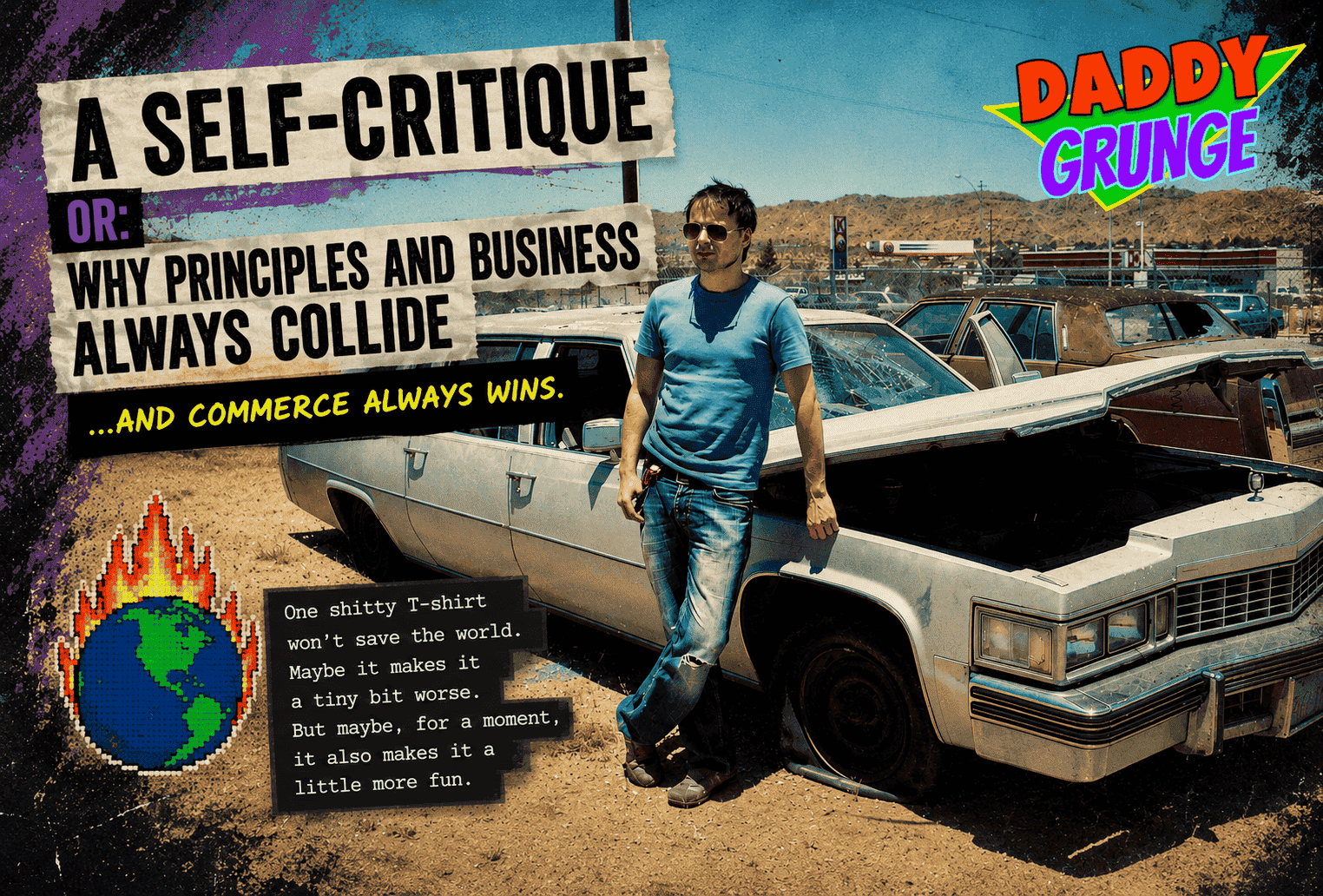
    A Self-Critique, or: Why Principles and Business Always Collide

    …and Commerce Always Wins.

    Wear Sunscreen

    Right now, it’s very hot in Germany. Hotter than ever before since meteorological records began. And there is a scientific consensus that the Earth’s atmosphere is heating up because of growing fossil fuel emissions. Climate change is, for the most part, man-made — caused by the industrialised nations and by people like me who open yet another print-on-demand online shop.

    Back in the ’90s, humanity already knew that this problem had to be tackled globally. One generation later, laws and regulations have come into force that can be traced back to those decisions, increasingly taxing the use of fossil fuels and the release of greenhouse gases.

    Naturally, this drives up energy prices and the cost of living. It confronts people here with complex decisions about major purchases — a car, a heating system — as well as everyday life. Complexities that make them angry. Angry enough that, among other things, populism is once again finding fertile ground.

    The Show Must Go On

    Surely we can’t be expected to rethink — let alone sacrifice — the routines we’ve worked so hard to build. Things like flying abroad twice a year or ordering T-shirts made in Bangladesh online.

    And consumption just keeps rolling on as if there were no tomorrow. But heaven forbid petrol or electricity should become more expensive.

    This particular high, carrying neo-nationalist undertones since 2001, goes hand in hand with global capitalism. It seems to be drifting into ever more brutal resource conflicts while still showing no sign of slowing down. Meanwhile, large parts of the population outside the glorious West are only now reaching a level of prosperity they have no intention of giving up.

    Killing in the Name

    As a result, more and more people are competing for limited natural resources. Habitats for animals and plants are disappearing faster and faster. Energy and housing costs continue to rise — after all, building materials are natural resources too — and the public mood grows rougher and hotter, all beneath the steadily warming cheese dome we call our atmosphere.

    Does the world really need another brand shipping T-shirts with 90s-inspired designs around the globe from a print-on-demand shop?

    Certainly not.

    So why am I doing it anyway?

    Especially considering how little it fits the 80s kid I used to be — the one who always took the final warning in wildlife documentaries to heart: that shrinking habitats were pushing those fascinating creatures towards extinction.

    The teenager who never understood the never-ending party called the Love Parade because, to him, it always looked like dancing on the edge of a volcano.

    My Favourite Game

    Today I understand that all of this has a lot to do with life itself.

    One person pours a lot of money into a classic car, drives it once a year to meet fellow enthusiasts, and spends the rest of the year simply polishing it.

    I just happen to enjoy making music, so I combine everything I’m reasonably good at — entertaining, drawing, songwriting and creating content — into one project.

    The tax office calls that a hobby business.

    Everybody else calls it a quirk.

    Only now have I truly understood sayings like “to each their own” or “live and let live.”

    Maybe collectively remembering old songs distracts us from crises and guilty consciences for a little while.

    We need reflection.

    A pause.

    And a little more optimism.

    One shitty T-shirt won’t save the world.

    It might even make it a tiny bit worse.

    But maybe, just for a moment, it also makes it a little more fun.

    And as long as nobody is buying too many of them, Daddy Grunge doesn’t really have a moral conflict on its hands.

    So, let the fuckening begin.